
Reviewed · TANDEM SKYDIVING
Bay of Islands: 9000ft Skydive
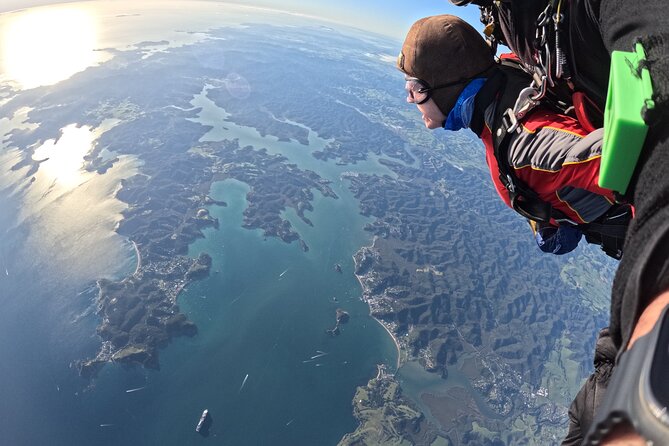
The Bay of Islands looks best from the sky. This tandem jump pairs a 9,000-foot aircraft exit with wide views of islands, beaches, and open sea, while an instructor handles the technical work. I like the included transfers from central Paihia, Kerikeri, or the cruise port, and I like that the flight gives you a rare view of the Northland coast from above. The main drawback is time: a jump that may take 1.5 hours can stretch to four when weather or flight operations cause delays.
You will freefall with a trained instructor, then spend the calmer part of the experience under the parachute. On a clear day, you may see the meeting point of the Tasman Sea and Pacific Ocean, along with Russell, Paihia, Waitangi, Cape Brett, and the islands scattered across the bay. The operation has a strict 100-kilogram weight limit, and the schedule can be less predictable than the advertised four-hour estimate.
In This Review
- Key points before you book
- What the $204.11 price buys you
- Arriving at 182 Wiroa Road in Kerikeri
- The ground briefing and waiting period
- The 9,000-foot jump and freefall
- Looking down on 144 Bay of Islands
- Why weather matters so much
- Transfers from Paihia, Kerikeri, and the cruise port
- Who will enjoy this most
- Practical details that can save you trouble
- Should you book the Bay of Islands 9000ft Skydive?
- FAQ
- Where does the skydive start?
- Where does the activity end?
- How high is the jump?
- How long does the experience take?
- Are transfers available?
- What is the maximum weight?
- Are photos and video included?
- What should I wear?
- Do I need to confirm the jump before arriving?
- Can I cancel for a refund?
Key points before you book
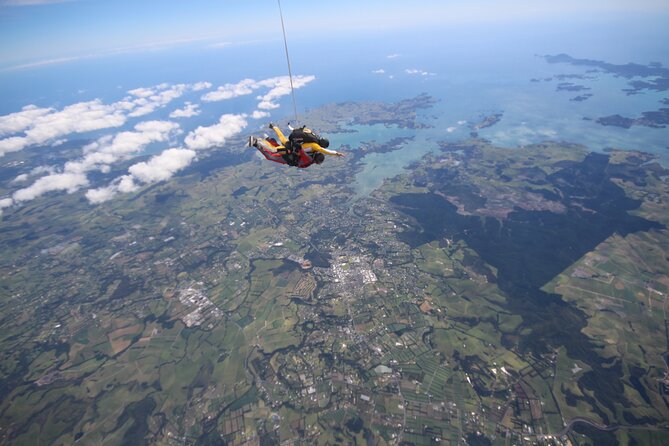
- The jump begins at about 9,000 feet: You get a thrilling freefall followed by a slower parachute descent.
- The scenery is the main prize: The Bay of Islands includes 144 islands, with views toward Russell, Paihia, Waitangi, Cape Brett, and Cape Reinga.
- Transfers are available: Complimentary pickup is offered from central Paihia, Kerikeri, and the cruise port.
- Plan around weather: You must call one hour before your jump to confirm conditions, and delays can extend the visit from 1.5 hours to as much as four.
- The 100-kilogram limit is firm: Contact the operator in advance if your weight may be close to the limit.
- Photos and video cost extra: Your instructor takes them during the flight, but souvenir media is not included in the price.
What the $204.11 price buys you
At the listed price of $204.11 per person, this is not a casual sightseeing flight. You are paying for an aircraft ride, professional tandem instruction, safety equipment, the jump itself, and a memorable view of one of New Zealand’s most scenic coastal areas.
The value depends on what you want from your Bay of Islands visit. A boat trip keeps you at sea level and may show you wildlife or hidden coves. This experience gives you a much broader view in a shorter burst of time. You can see how the islands fit together, how the coastline curves around the bay, and how small the settlements look from the air.
I would also factor in the included transfers. If you are staying in central Paihia or Kerikeri, you may not need to arrange a taxi or rental car for the visit. Pickup is also offered at the cruise port, which makes this a possible option for a port day, though the weather delays deserve careful thought if your ship has a firm departure time.
Photos and video are extra. That is common for tandem jumps, but it can change the final cost. If you want a record of the jump, ask about the media package before boarding rather than treating it as an unexpected add-on afterward.
Arriving at 182 Wiroa Road in Kerikeri
The meeting point is at 182 Wiroa Road, Kerikeri. The activity ends at the same location, unless you use one of the offered transfer services.
Bring your printed ticket or voucher. The instructions specifically require a printed copy at the drop zone, so do not rely only on a mobile confirmation. A mobile ticket is offered when booking, but the arrival instructions still call for paper documentation.
Wear comfortable clothing and closed-toe shoes. You will receive the required training and safety equipment on site, but sensible clothing will make the harness and preparation easier. The experience requires a moderate level of physical fitness, and anyone with a medical condition that could affect jumping should get professional medical advice first.
Customers under 18 need signed consent from a parent or guardian. You also need to avoid the activity for at least 24 hours after scuba activity because of pressure changes.
The ground briefing and waiting period
The actual jump is only one part of the visit. You will first check in, complete the required preparation, receive instructions, and be matched with your tandem instructor. The instructor manages the jump procedure, but you still need to listen carefully and follow directions.
The operation allows up to 20 people. That maximum is not enormous, but the experience can still involve waiting. One customer described a long processing period before their group was called, with roughly 25 people ahead of them and their group going last. The same account praised the instructors as fantastic and described the operation as very safety-conscious.
That combination tells you what to expect: competent instruction, but not necessarily a fast-moving visit. If you have a restaurant booking, bus connection, or ship departure, leave plenty of room. The operator asks you to allow two to four hours, even though the jump itself typically takes about 1.5 hours.
The safety emphasis is a positive feature. Still, delays may feel frustrating when you are already dressed and waiting for your turn. I would bring water, keep your schedule open, and treat the time window as part of the outing rather than assuming you will be finished quickly.
The 9,000-foot jump and freefall
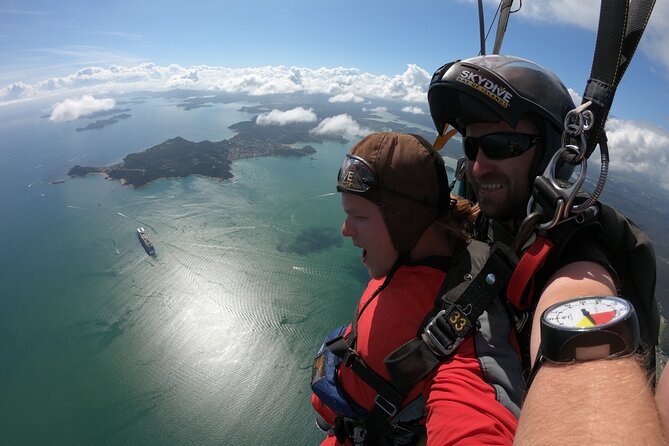
At around 9,000 feet, or 2,750 meters, you leave the aircraft attached to your tandem instructor. You do not need to manage the parachute system yourself. Your instructor takes responsibility for the technical steps, allowing you to concentrate on the sensation and the view.
The first portion is the high-energy freefall. It is the part that attracts most people to a skydive, and it can feel intense even when you have chosen a tandem jump for its guided format. After that comes the canopy descent, which is slower and gives you more time to look around.
The contrast matters. The freefall is about adrenaline and physical sensation. The parachute portion is where the Bay of Islands becomes easier to appreciate. You may have time to identify the islands and coastal towns below, and on a clear day you can look toward the broad meeting area of the Tasman Sea and Pacific Ocean.
The instructor also takes photos and video during the experience. These are available to purchase afterward. If recording the moment matters to you, budget for it. If it does not, the view itself remains the central included feature.
One customer reported an uncomfortable comment from an instructor named Andrew when they were nervous. The wording described was not reassuring, and the person also disliked being moved by the harness. This is worth noting because tandem instructors must handle nervous customers firmly, but clear, calm communication matters. The broader feedback praises the instructors and safety standards, yet this individual account shows that the personal tone may vary.
Looking down on 144 Bay of Islands
The Bay of Islands is made up of 144 islands, with clear water, secluded beaches, and a long coastline. From the aircraft and parachute, the attraction is not one single landmark. It is the pattern of land and sea spread beneath you.
You may see:
- Paihia: A coastal town often visible during the jump, with broad views across the bay.
- Russell: The historic waterfront town across the water from Paihia.
- Waitangi: The birthplace of modern New Zealand, known for its important place in the country’s story.
- Urupukapuka Island: The largest island in the bay, with walking tracks and clear surrounding water.
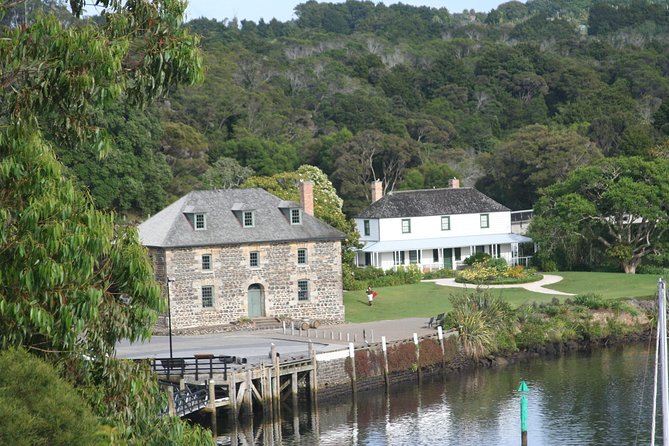
- Kerikeri: An inland historic town near New Zealand’s oldest stone buildings, surrounded by green country.
- Cape Brett: A rugged coastal area marked by a famous rock formation with a natural arch.
- Cape Reinga: The far northern point where the Pacific Ocean and Tasman Sea meet. It is not normally directly visible during most jumps, but it provides useful geographic context for the region.
- Matauri Bay: Home to a memorial connected with the Rainbow Warrior, bombed in 1985.
Do not expect to land at these places or stop for visits. They are reference points and possible views from above. The itinerary is best understood as an aerial route over the Bay of Islands, not a sightseeing circuit with ground stops.
Visibility will shape the experience. On a clear day, the mix of blue water, islands, beaches, and distant headlands should be impressive. Cloud or poor conditions can reduce the views and may stop the jump altogether. That is why the required one-hour call before the scheduled time is important.
Why weather matters so much
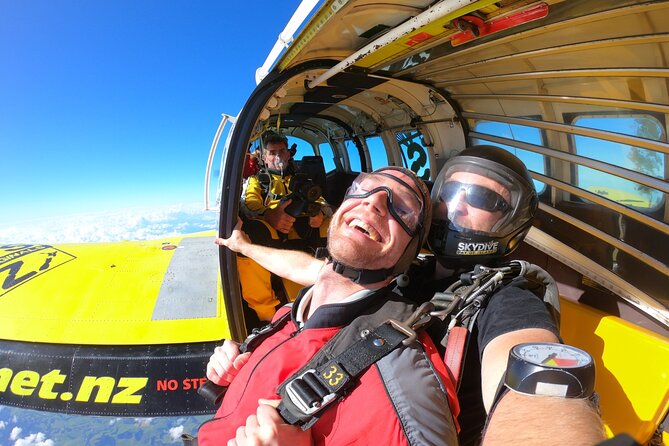
This is an aviation activity, not a fixed-time attraction. The operator asks every customer to call one hour before the jump to confirm that conditions are suitable. Weather can change the flight schedule, the views, or the decision to postpone the jump.
You should treat your booking time as a target, not a guarantee. The usual completion time is about 1.5 hours, but the operator asks you to allow two to four hours because of weather changes and unexpected operational needs.
I would book this early in a Bay of Islands stay rather than on your final afternoon. That gives you some chance to reschedule if conditions do not cooperate. If you are visiting on a cruise, be especially cautious. Pickup from the cruise port is useful, but a delayed jump could create pressure before you need to return to the ship.
The cancellation terms are reasonable if you plan ahead. You can cancel for a full refund up to 24 hours before the start time. Changes or cancellations inside that period are not accepted, and a missed weather-related opportunity may require coordination with the operator rather than a last-minute change through the booking system.
Transfers from Paihia, Kerikeri, and the cruise port
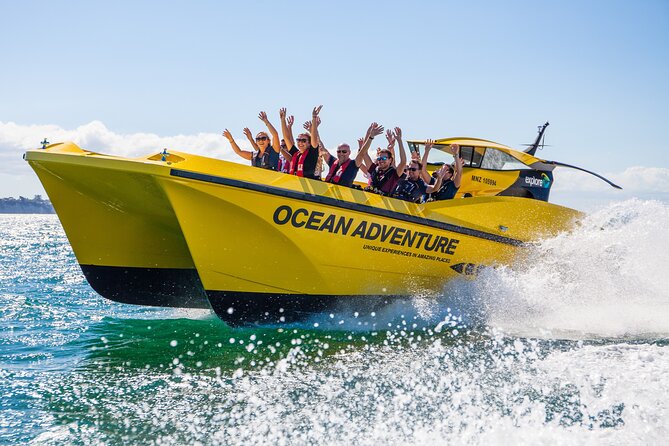
Complimentary collection is offered from central Paihia and Kerikeri, with pickup also available from the cruise port. If you are unsure if your accommodation qualifies, the operator asks you to call 0800 GOJUMP.
The transfer service adds real value for visitors without a car. Kerikeri is the meeting-point town, while Paihia sits across the bay, so arranging your own transport could otherwise add cost and planning. Hotel pickup also lets you focus on the weather call and arrival time instead of navigating unfamiliar roads.
Spectators may be able to use the shuttle, but people booked to jump receive priority. If the vans reach capacity, spectators may need to arrange other transportation. That is a small but important detail if family or friends are coming along without jumping.
Who will enjoy this most
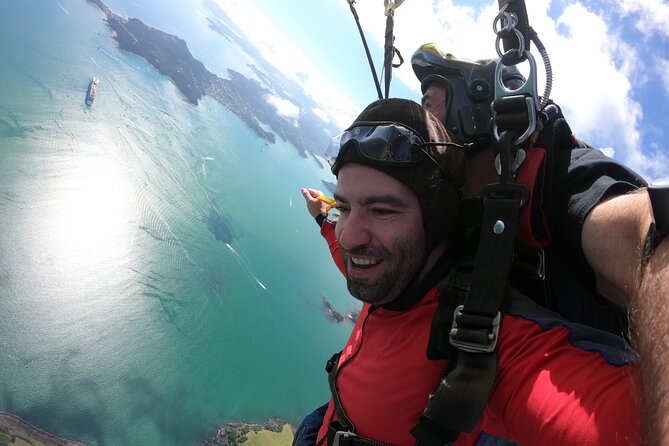
This experience suits you if you want one major thrill during a Northland visit and care as much about the aerial view as the freefall. It works especially well for couples, friends, and solo visitors who want a memorable story rather than another quiet coastal activity.
It may also suit cruise passengers, provided you have a generous time buffer. The port transfer is helpful, but I would not book the latest possible slot before ship departure.
You should think carefully before booking if you dislike uncertain schedules, are close to the weight limit, or want a relaxed sightseeing trip. Waiting, weather changes, and the possibility of extra media costs are all part of the decision.
If you are nervous, tell your instructor clearly before the flight. The available feedback points to strong safety awareness and positive instructors overall, but one account shows that the communication style may not always feel gentle. You need to be comfortable asking questions and speaking up if instructions or handling make you uneasy.
Practical details that can save you trouble
A few simple preparations make this experience easier:
- Call one hour before the scheduled jump to confirm conditions.
- Bring a printed ticket or voucher.
- Wear comfortable clothes and closed-toe shoes.
- Leave two to four hours free, not just the advertised 1.5 hours.
- Keep your weight below the strict 100-kilogram limit, or call if you may be close.
- Allow at least 24 hours after scuba activity before jumping.
- Arrange consent in advance if you are under 18.
- Give at least 48 hours notice if you need to reschedule or cancel.
- Ask about photo and video prices before the flight.
- If you are using a cruise-port pickup, leave a wide return window.
The operator allows service animals, and all training and safety equipment is provided. The experience is limited to a maximum of 20 people, although the waiting time may still feel long when several groups are being processed.
Should you book the Bay of Islands 9000ft Skydive?
Book it if you want a major burst of adrenaline paired with one of New Zealand’s best coastal views. The 9,000-foot height offers a strong balance: enough altitude for a thrilling freefall, followed by a slower descent where you can look across the 144 islands. Included transfers make the listed price more attractive, especially from Paihia or Kerikeri.
I would skip it if your schedule is tight, your cruise departure is close, or you want guaranteed clear views. The strongest reasons to book are the scenery, tandem format, and safety-focused operation. The strongest reasons to hesitate are the weather risk, possible waiting, strict weight limit, and extra charge for photos and video.
For most suitable customers, this is a memorable way to see the Bay of Islands from a completely different angle. Just book early in your stay, keep your day flexible, and call before setting out.
FAQ
Where does the skydive start?
The meeting point is 182 Wiroa Road, Kerikeri 0293, New Zealand.
Where does the activity end?
The experience ends back at the meeting point in Kerikeri.
How high is the jump?
The aircraft exit is from about 9,000 feet, or 2,750 meters.
How long does the experience take?
The skydive typically takes about 1.5 hours, but you should allow two to four hours for weather changes and unexpected aviation requirements.
Are transfers available?
Yes. Complimentary collection is offered from central Paihia and Kerikeri, and pickup is also available from the cruise port. Call 0800 GOJUMP if you are unsure about your pickup location.
What is the maximum weight?
The operator has a strict 100-kilogram weight limit. Contact the operator if you think you may be close to that limit.
Are photos and video included?
No. The instructor takes photos and video that you can purchase after the jump. Souvenir photos and DVD media are not included in the price.
What should I wear?
Wear comfortable clothing and closed-toe shoes. Training and safety equipment are provided.
Do I need to confirm the jump before arriving?
Yes. You must call one hour before your scheduled jump time to confirm that conditions are suitable.
Can I cancel for a refund?
You can cancel up to 24 hours before the experience start time for a full refund. Changes or cancellations made less than 24 hours beforehand are not accepted.
More Skydiving
- Skydive Auckland
★ 5.0 · 1,516 reviews - NZONE Skydive Queenstown
★ 4.5 · 1,438 reviews - Queenstown: Tandem Skydive Experience
★ 4.8 · 475 reviews - Lake Taupo 12,000-Foot Tandem Skydiving
★ 5.0 · 359 reviews
Tandem Skydiving, compared.
15,000ft Tandem Skydive in Tauranga – Bay of Plenty
Read our review →
Browse the lists this tour appears in