
Reviewed · HELICOPTER TOURS
The Adventurer: Tasman Glacier Heli-hike
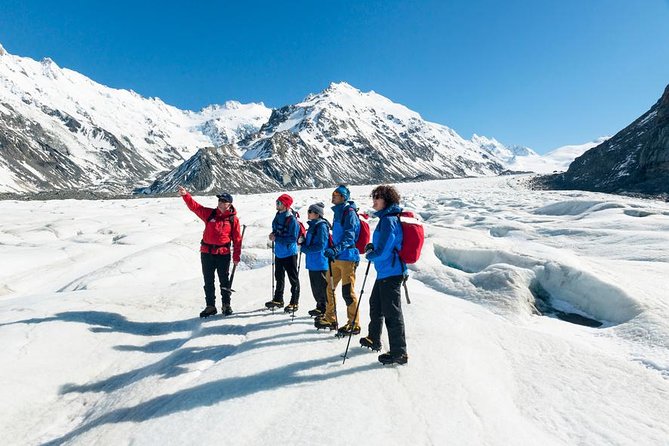
The glacier is only the beginning. The Tasman Glacier Heli-hike combines two scenic helicopter flights with a guided walk across remote ice near Aoraki/Mount Cook, New Zealand’s highest peak. You fly to a high landing point, fit crampons or snowshoes, and explore ice caves, blue-white holes, snowfields, and other formations that would take a serious overland journey to reach.
I especially like the small maximum group of 11, which gives your guide room to watch everyone’s footing and point out details you could easily miss. I also like the generous equipment package, including leather boots, wool socks, waterproof clothing, poles, and winter snowshoes when needed. The main drawback is the price, $572.23 per person, and the fact that poor weather can cancel or delay the outing.
In This Review
- Key points to know before you book
- Why the Tasman Glacier Heli-hike feels different
- Starting at Mount Cook Airport
- The first flight over Aoraki/Mount Cook
- Landing on the Tasman Glacier at 1,300 meters
- What the guide adds to the walk
- The return flight and the full three-hour rhythm
- Is $572.23 good value?
- Who should book this experience?
- Practical preparation for a cold glacier
- Booking, cancellations, and weather decisions
- Should you book the Tasman Glacier Heli-hike?
- FAQ
- Where does the Tasman Glacier Heli-hike start?
- Where does the activity finish?
- How long does the heli-hike last?
- How high does the glacier walk reach?
- Is equipment provided?
- What clothing should I bring?
- Does the tour operate in poor weather?
- How many people can join the group?
- Can I cancel for a full refund?
Key points to know before you book
- Two helicopter flights give you a scenic fly-by of Mount Cook and access to a remote part of the Tasman Glacier.
- The glacier walk reaches about 1,300 meters, or 4,265 feet, where the ice is far beyond the usual roadside viewpoint.
- Guides cut steps in the glacier and use mountaineering skills passed down from New Zealand’s early mountain pioneers.
- Ice caves, tunnels, holes, and fresh snow can turn the walk into a hands-on exploration rather than a simple photo stop.
- Boots, socks, crampons, poles, and waterproof layers are supplied, but you still need warm clothing underneath.
- Weather controls the schedule, and the operator cannot hold a helicopter departure for late arrivals.
Why the Tasman Glacier Heli-hike feels different
A normal visit to Aoraki/Mount Cook National Park may give you grand mountain views, but it does not put you on the ice. This outing changes the scale of the experience. From the helicopter, the glacier appears broad and remote. On foot, you notice small ridges, meltwater, blue ice, deep cracks, and changing textures.
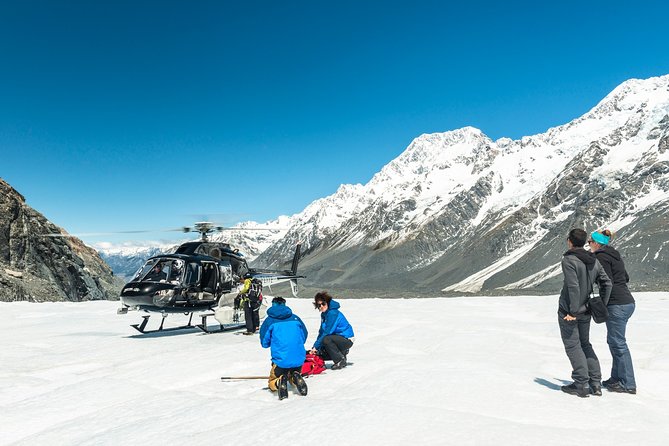
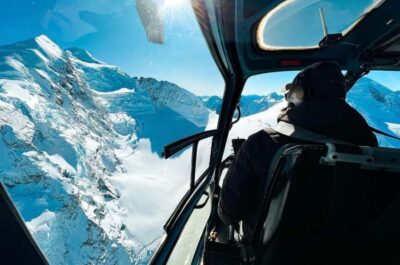
The helicopter flight is not just transportation. It is one of the main attractions. The route includes views of Aoraki/Mount Cook, and the return flight provides another chance to see the glacier from above. Some flights also include close views of ice on a mountain face or small avalanches, depending on conditions and the route chosen by the pilot.
Once you land, the guide fits your crampons or snowshoes and explains how to move safely. The walk is guided throughout, with the route shaped by the current condition of the ice. That matters because a glacier is not a fixed trail. Meltwater, snow, openings, and ice formations change over time.
The experience lasts about three hours from the Mount Cook Airport base. That makes it practical for a day in the Aoraki/Mount Cook area, though you should leave room in your schedule for weather changes. Helicopters cannot operate on a tight clock when wind, cloud, or visibility are poor.
More Helicopter Flights in the Mackenzie
- Mount Cook: Scenic Helicopter Flight with Alpine Landing
★ 4.8 · 442 reviews - Mount Cook: Ski Plane and Helicopter Glacier Combo Flight
★ 4.6 · 271 reviews - Mount Cook and The Glaciers 55-Minute Helicopter Flight
★ 4.5 · 133 reviews
Starting at Mount Cook Airport
You meet at Mount Cook Airport on Mount Cook Road, in the Canterbury region. The activity ends back at the same meeting point, so you do not need to arrange separate transport from the glacier.
Expect a preparation period before takeoff. You receive the supplied footwear and outer layers, and the team checks what you are wearing before you head out. Bring three or four warm upper-body layers, warm trousers, sunglasses, sunscreen, a hat, gloves, water, and snacks.
Do not arrive in jeans. They are not a good choice for cold, wet conditions, and the operator specifically asks for warm trousers instead. The supplied waterproof jacket and over-trousers help, but your own clothing still provides the main insulation.
You should also treat the departure time as firm. The operator says it cannot delay a flight because helicopter scheduling is strict. If you miss your confirmed time and the empty seat cannot be sold again, you can be charged the full amount. Arriving early is a simple way to protect a very expensive booking.
The first flight over Aoraki/Mount Cook
The first helicopter flight carries you toward a remote section of the Tasman Glacier. The aerial view gives you the best sense of scale: a wide sweep of ice, mountain slopes, snowfields, and the high country surrounding Aoraki/Mount Cook.
The flight includes a fly-by of Mount Cook, so you get a clear mountain perspective before landing. Seating may not be equally ideal for every person on both flights, but the team has sometimes changed seating between the outbound and return legs so everyone receives a window or front-seat view at least once.
That is a thoughtful touch, since the views are a major part of what you are paying for. Even so, you should not book this expecting a private helicopter. The maximum group size is 11, and seating depends on the aircraft and operating arrangements.
The helicopter ride also brings some uncertainty. Wind and cloud can affect the route or prevent the flight altogether. If weather makes the trip unsafe, you can choose another date or receive a full refund. Build that flexibility into your Mount Cook plans instead of scheduling the heli-hike immediately before a flight or long drive.
Landing on the Tasman Glacier at 1,300 meters
After landing at roughly 1,300 meters, or 4,265 feet, you prepare for the walk. The team supplies quality leather boots and wool socks, along with a harness if required, adjustable walking poles, crampons, and winter snowshoes when conditions call for them.
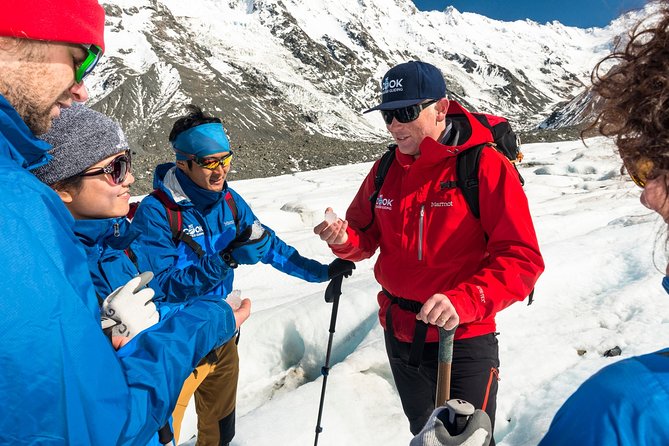
Crampons give you traction on harder ice, while snowshoes help in deeper winter snow. Your guide decides what suits the current surface. You do not need to bring technical glacier equipment, which removes a major barrier for people who want to try a glacier walk without owning mountaineering gear.
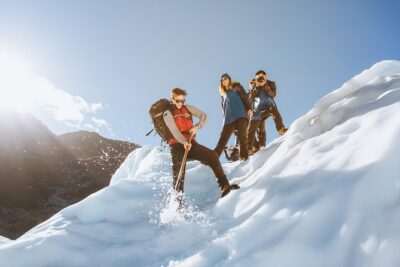
The guide then leads you across the ice. Depending on the day, you might see tunnels, caves, fresh snow, holes, slush, and blue-white formations. One outing included a descent of about ten feet into a blue-white opening with water moving below. Another included glacier water and a slushie made from glacier ice.
These details explain why the walk is more than a scenic pause beside a helicopter. You are not simply looking at the glacier. You are walking over it, touching its ice, and seeing how water and temperature shape it.
More hiking tours:
- Glentanner High Country Heli Hike
★ 5.0 · 52 reviews - Franz Josef Glacier Heli-Hike
★ 4.5 · 618 reviews - Heli Hike Fox Glacier
★ 5.0 · 563 reviews - Queen Charlotte Track: Cruise & Self-Guided Hike from Picton
★ 4.8 · 383 reviews
What the guide adds to the walk
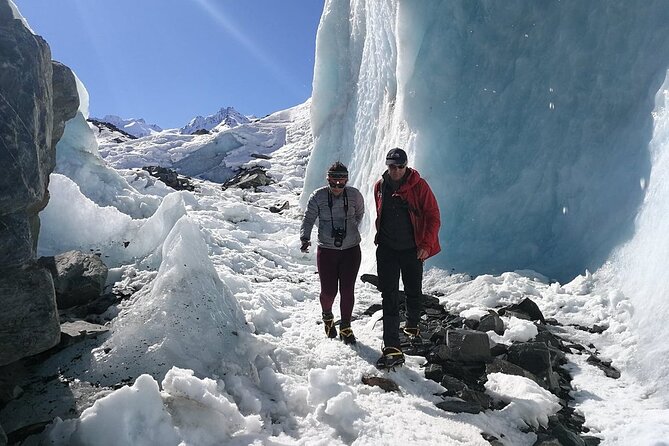
The guide is the key to making the ice understandable. The route is not marked like a public walking track, so you rely on the guide to choose a safe path and interpret what you are seeing.
Guides cut steps in the glacier when needed, using techniques linked to New Zealand’s early mountain pioneers. That gives the walk a genuine mountaineering flavor without requiring you to plan or lead a technical route yourself.
Names that have received particular praise include Flav, Hunter, Fiona, Richard, Pawel, and Anna. Hunter was singled out for making the outing both fun and informative. Richard was praised for finding unusual sights, including an ice tunnel and cave, while Fiona was noted for her strong guiding on a morning outing.
You should still expect the exact route and sights to vary. Ice caves may open or close, water levels shift, and fresh snow changes the surface. A good guide works with those conditions rather than promising a fixed set of formations.
Safety also receives careful attention. Before heading onto the ice, the guide explains how to behave around the helicopter and glacier. The small group helps here, since the guide can keep a closer eye on footing, equipment, and anyone who needs a slower pace.
The return flight and the full three-hour rhythm
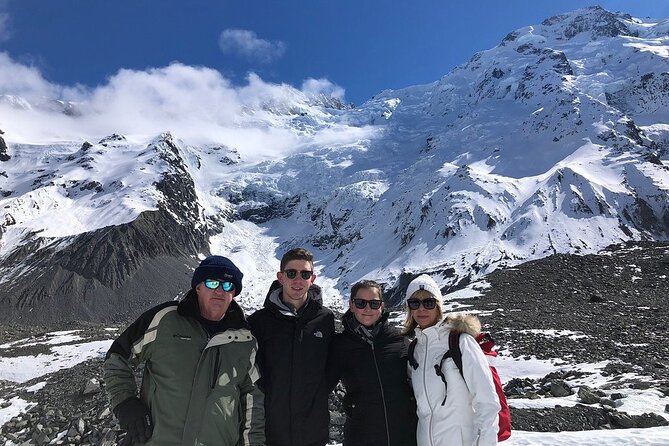
Once the glacier walk ends, you return by helicopter to the Aoraki/Mount Cook base. The second flight is not an afterthought. It gives you another aerial look at the ice and mountains, often from a different angle than the outbound trip.
The total outing is listed at about three hours, but the active time on the glacier can vary. Preparation, equipment fitting, flight conditions, and the day’s route all affect the pace. The descriptions of outings on the ice include roughly two hours of glacier activity, but you should treat that as an example rather than a promise.
The rhythm works well: flight, equipment fitting, guided exploration, then a second scenic flight. You get both the grand view and the close-up view, which is the strongest reason to choose this over a standard scenic flight alone.
Is $572.23 good value?
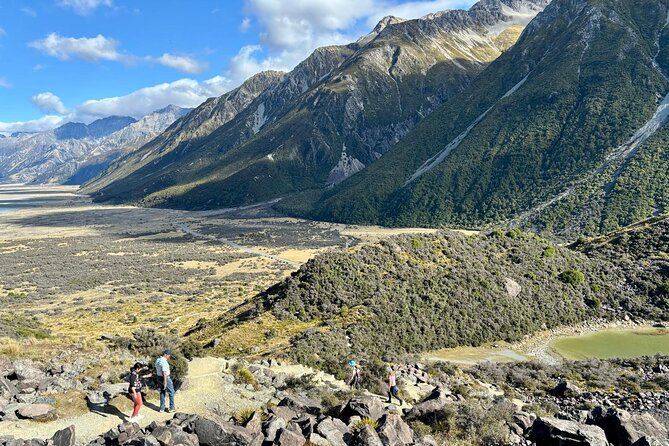
At $572.23 per person, this is a costly excursion. You are paying for two helicopter flights, a professional guide, specialist equipment, airport operations, and access to a remote part of the Tasman Glacier. It is not a budget walk, and the short duration may make the price feel steep if you judge it only by hours.
I think the value depends on what you want from Mount Cook. If you only need dramatic mountain scenery, roadside viewpoints and regular walks cost far less. If you want to stand on remote glacier ice without arranging a difficult expedition, the helicopter makes that possible in a compact outing.
The supplied boots, wool socks, crampons or snowshoes, poles, and waterproof layers also save you from renting or buying gear. You still need to bring warm clothing, but the operator handles the technical kit.
For a special occasion or the main adventure of a South Island road trip, the price can make sense. For a family trying to keep daily costs low, it may be harder to justify, especially if weather makes the schedule uncertain.
Who should book this experience?
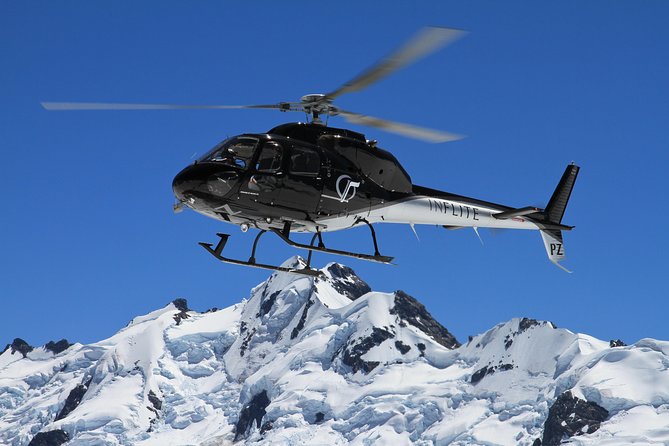
You should consider booking if you have moderate physical fitness and are comfortable walking on uneven ice with crampons or snowshoes. You do not need to be a mountaineer, since the guide handles the route and step cutting, but this is still an active outing rather than a passive sightseeing flight.
It suits visitors who want close contact with the glacier, photographers who value changing ice formations, and anyone looking for a memorable Mount Cook experience beyond the usual valley walks.
It may not suit you if you dislike helicopters, have little flexibility in your schedule, or need a low-cost activity. You also need to accept that the glacier route is weather dependent and that the exact ice features cannot be guaranteed.
The age and accessibility details are not provided, so you should contact the operator directly if you have mobility concerns or need a specific accommodation.
Practical preparation for a cold glacier
Wear several thin warm layers rather than one bulky coat. The outer jacket and over-trousers supplied by the operator help protect you from wind and moisture, while your base layers keep you warm during pauses.
Bring sunglasses and sun protection even if the day looks cloudy. Snow and ice reflect strong light, and the glacier can feel bright at altitude. Pack water and snacks, since both are listed as items you should bring yourself.
Keep your camera or phone secure and protected from cold and moisture. You will likely have time for photos, but do not let picture-taking distract you from instructions near holes, caves, or changing ice.
Finally, check your communication from the operator before departure. Weather can remain uncertain until close to takeoff, and the team has provided updates when conditions were questionable. If a morning flight is canceled or moved, an afternoon departure may become available, but you should not assume a same-day replacement.
Booking, cancellations, and weather decisions
You can cancel for a full refund up to 24 hours before the local start time. Changes or cancellations inside that 24-hour window are not accepted for a refund.
The outing requires suitable weather. If the operator cancels because conditions are unsafe, you are offered another date or a full refund. The same type of choice applies if the minimum number of participants is not met.
Confirmation is sent within 48 hours of booking, subject to availability. Since this activity is limited to a maximum of 11 people, it is sensible to book ahead if your Mount Cook dates are fixed.
Should you book the Tasman Glacier Heli-hike?
I would book it if standing on the Tasman Glacier is high on your New Zealand wish list and the cost fits your trip. The combination of Mount Cook views, two helicopter flights, a guided ice walk, and supplied equipment gives you far more than a quick scenic flight.
The strongest reason to go is the change in viewpoint. You see the glacier from above, then walk among its caves, holes, snow, and meltwater. Just keep your plans flexible, arrive early, dress properly, and accept that nature gets the final say.
FAQ
Where does the Tasman Glacier Heli-hike start?
The experience starts at Mount Cook Airport on Mount Cook Road, in the Canterbury region of New Zealand.
Where does the activity finish?
The helicopter returns you to the Mount Cook Airport meeting point, where the activity ends.
How long does the heli-hike last?
The experience lasts approximately three hours.
How high does the glacier walk reach?
The glacier landing and walk take place at roughly 1,300 meters, or 4,265 feet.
Is equipment provided?
Yes. The operator provides leather boots, wool socks, a waterproof jacket, over-trousers, adjustable walking poles, and crampons. Snowshoes are used in winter when needed. A harness is provided if required.
What clothing should I bring?
Bring three or four warm upper-body layers, warm trousers, sunglasses, sun protection, a hat, and gloves. Jeans are not recommended. You should also bring water and snacks.
Does the tour operate in poor weather?
The experience requires favorable weather. If poor weather causes cancellation, you can choose an alternative date or receive a full refund.
How many people can join the group?
The maximum group size is 11 participants.
Can I cancel for a full refund?
Yes, if you cancel at least 24 hours before the local start time. Cancellations or changes made less than 24 hours before departure are not refunded or accepted.
Just added around Mount Cook
- Skydive Mt. Cook – 70+ Seconds of Freefall from 16,500ft★ 5.0 · 5 reviews
- Skydive Mt. Cook – 20+ Seconds of Freefall from 10,000ft★ 5.0 · 5 reviews
- Mount Cook Scenic 35 Minute Helicopter Flight★ 5.0 · 6 reviews
- Mt Cook: 55-Minute Scenic Flight in Helicopter or Ski Plane★ 4.1 · 6 reviews
- Mount Cook: 50-Minute Aoraki Scenic Helicopter Flight★ 4.7 · 10 reviews
- Skydive Mt. Cook – 45+ Seconds of Freefall from 13,000ft★ 5.0 · 14 reviews
- Mt Cook & Lake Tekapo 2-Day Small Group Tour from Queenstown★ 5.0 · 15 reviews
- Mt Cook to Christchurch One-Way Small Group Tour via Lake Tekapo★ 5.0 · 16 reviews
Helicopter Tours, compared.
Franz Josef Glacier: Helicopter Flight & Alpine Landing
Read our review →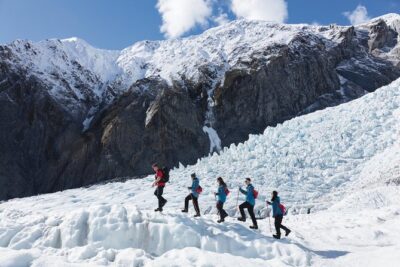
Mount Cook: Scenic Helicopter Flight with Alpine Landing
Read our review →
Franz Josef & Fox Glaciers Helicopter Flight & Snow Landing
Read our review →
Milford Sound Small Group Tour from Queenstown with Scenic Flight
Read our review →
2.5 Hour Glacier Hike with Helicopter Transfer
Read our review →Browse the lists this tour appears in