
Reviewed · LAKE TEKAPO STARGAZING
Mount John Observatory Stargazing Experience, Tekapo
The stars here feel close enough to touch. From Mount John’s 1,029-metre summit, I like the combination of pristine dark skies and serious observatory equipment, along with guides who make astronomy easy to follow. The return ride from Lake Tekapo also keeps the evening simple. The main drawback is weather: clouds can cancel the summit visit, and the indoor backup may feel thin compared with the real thing.
I also like that you see the Southern Hemisphere sky with both your own eyes and through powerful telescopes. You may learn the Southern Cross, find the true southern star, spot Jupiter’s moons, and view distant star clusters. Just prepare for cold, darkness, and a little walking on uneven ground.
In This Review
- Key points at a glance
- Why Mount John is the right place for stargazing
- Stop one: checking in at Dark Sky Project
- Stop two: the Mount John summit after dark
- The guides make the difference
- Three telescopes and what that means for you
- Cold, darkness, and practical comfort
- Cloud cover is the big risk
- Is the $139.39 price good value?
- Who will enjoy this most?
- What to bring and how to plan
- Should you book the Mount John experience?
- FAQ
- Where does the experience begin?
- How long does the experience last?
- How high is Mount John Observatory?
- What will I see during the stargazing?
- Are telescopes included?
- Are warm clothes provided?
- What happens if the weather is bad?
- Can children join the experience?
Key points at a glance
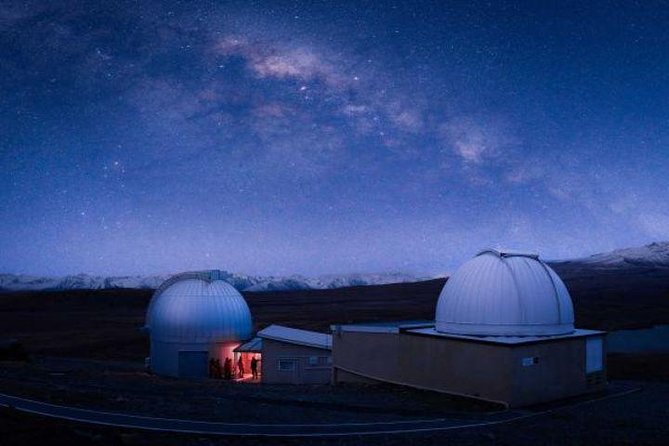
- Mount John summit access: Ride from Lake Tekapo to the University of Canterbury observatory at 1,029 metres.
- Two ways to see the sky: Guides combine naked-eye stargazing with laser pointers and advanced telescopes.
- Small evening groups: The advertised limit is 22 people per departure, with an overall activity maximum of 30.
- Cold-weather gear supplied: Extreme Weather Coats are provided, but warm layers still matter.
- Weather controls the experience: Poor conditions can lead to a new date, refund, or alternate indoor session.
- Good for beginners: The guides explain stars, constellations, planets, and distant objects without assuming much prior knowledge.
Why Mount John is the right place for stargazing
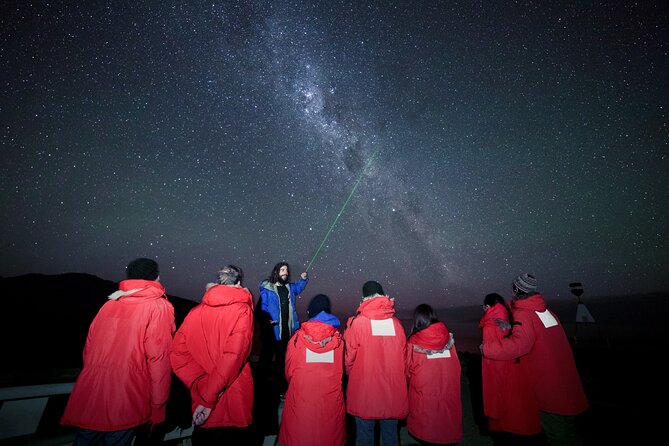
Lake Tekapo sits inside the Aoraki McKenzie International Dark Sky Reserve, a vast protected area with exceptionally limited artificial light. Mount John puts you above the town and surrounding lakes, inside one of the best-known astronomy settings in New Zealand.
That location matters. A dark sky is not just a pretty backdrop. It lets you see far more stars than you would from a city or ordinary holiday town. The Milky Way becomes easier to trace, and faint clusters and distant objects have a better chance of appearing through the telescopes.
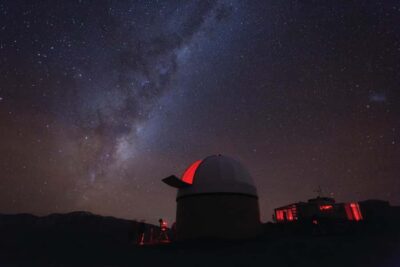
The summit is also home to the University of Canterbury Mt. John Observatory, an active research centre and an internationally recognised facility. You are not simply taken to a scenic hill for a quick look upward. The setting gives the guides a genuine connection to astronomy and to the scientific work carried out there.
Still, expectations need to be sensible. The sky changes from night to night. A full moon can reduce the visibility of the Milky Way, while clouds can block the telescopes entirely. One useful tip from the experience is to consider a night without a full moon if your main goal is seeing the darkest possible sky.
More Lake Tekapo stargazing:
- Lake Tekapo: Alpine Stargazing Experience with a Guide
★ 4.5 · 626 reviews - Lake Tekapo: Stargazing Experience
★ 4.9 · 607 reviews - Chameleon Stargazing Shared Tour
★ 5.0 · 181 reviews
Stop one: checking in at Dark Sky Project
Your evening begins at the Dark Sky Project in Lake Tekapo. This is the meeting point, and the included transport takes you up to the summit. The transfer is listed as taking about 15 minutes, followed by roughly 90 minutes at the observatory.
That arrangement is valuable because you do not need to arrange your own drive up the mountain. It also avoids the stress of navigating a dark road after the session. Hotel pickup is not included, so you need to reach the Dark Sky Project in Tekapo township yourself.
The departure point is more than a place to wait for a bus. It is where the team can confirm the conditions and prepare you for the mountain. If you are booking a departure after midnight, check the date carefully. Late-night times can easily be confused with the previous evening.
The advertised group size is limited, with a maximum of 22 people per departure time and an overall activity limit of 30. That is not an intimate private tour, but it is more manageable than a large coach outing. The size can still affect your view at the telescopes, especially if everyone wants a turn at once.
Stop two: the Mount John summit after dark
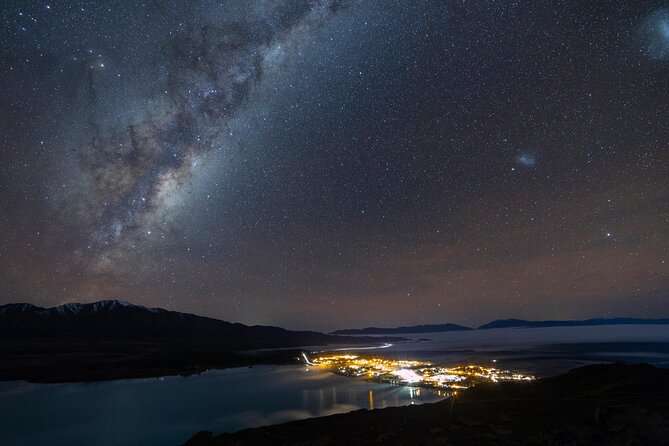
At the top, the experience shifts from transport to guided sky watching. The guides explain the Southern Hemisphere’s stars and constellations, using laser pointers to direct your attention. This is especially helpful at the beginning, when the sky can look like a dense scatter of lights rather than a readable map.
You may be shown the Southern Cross and helped to identify the true southern star. One memorable teaching point is the difference between the real southern star and the so-called false southern star. Details like this give you something practical to take away. After the tour, you have a better chance of recognising familiar patterns instead of simply remembering a beautiful blur.
The naked-eye portion is important. Telescopes are exciting, but your first view of the Milky Way does not need machinery. On a clear night, the scale of the sky can be striking on its own. Guides may also point out planets, constellations, solar systems, star clusters, and perhaps a distant galaxy, depending on the season and conditions.
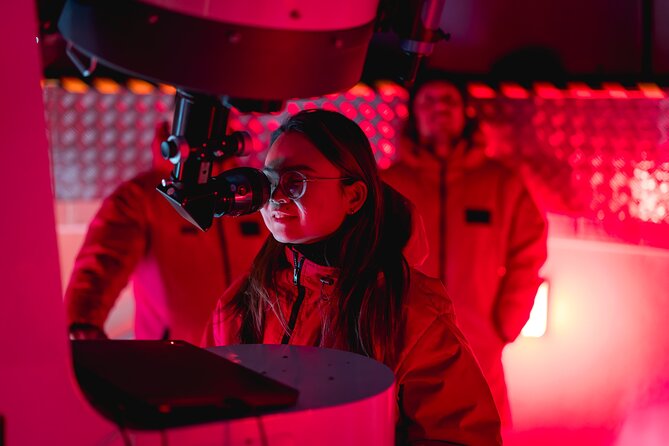
The experience then moves to telescope viewing. The equipment lets you inspect objects that would be difficult or impossible to see clearly with the naked eye. Previous sessions have included views of Jupiter’s moons, old star clusters, and young stars. What appears will depend on the sky, the time of year, and the equipment in use that evening.
The guides make the difference
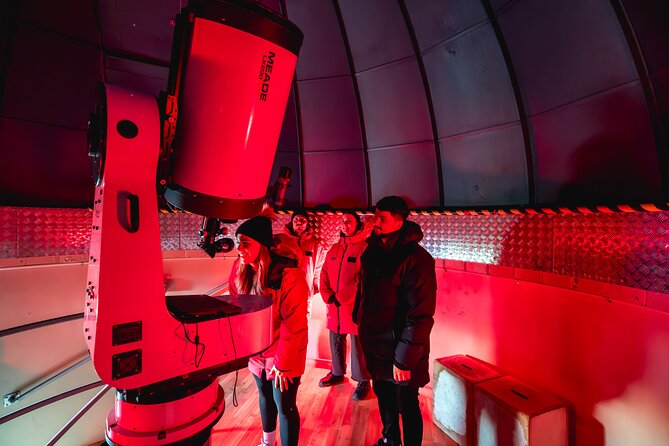
Astronomy can become dry very quickly if it is presented as a list of names and numbers. Here, the strongest part of the experience is the way guides connect the science to what you are actually looking at.
The guide team is described as enthusiastic, entertaining, and easy to follow. That suits beginners, families, and anyone who has only a passing interest in the night sky. You do not need to arrive knowing the difference between a planet, star cluster, and galaxy.
Some guide names noted during sessions include Kieran, Alice, and Olive. The team may vary, but the useful pattern is consistent: clear explanations, active direction, and plenty of time for questions. English and Mandarin guiding are available, and you must be able to speak the language of your booked tour for safety reasons.
The astronomy is not reduced to a lecture. You are encouraged to look, compare, ask, and move between naked-eye views and telescope views. That makes the session feel active even when you are standing still in the cold.
A few more Lake Tekapo trips worth weighing up
- Tekapo Shuttle: Mt Cook Day Tour via Pukaki & Tasman Lake
★ 4.8 · 307 reviews - Lake Tekapo: Mountaintop Stargazing at Mount John Summit
★ 4.5 · 176 reviews - Lake Tekapo: Single Day Multiple Entry Pass for Hot Pools
★ 4.2 · 129 reviews - Tekapo Star Gazing Tour – Soak in the Stars
★ 4.5 · 109 reviews
Three telescopes and what that means for you
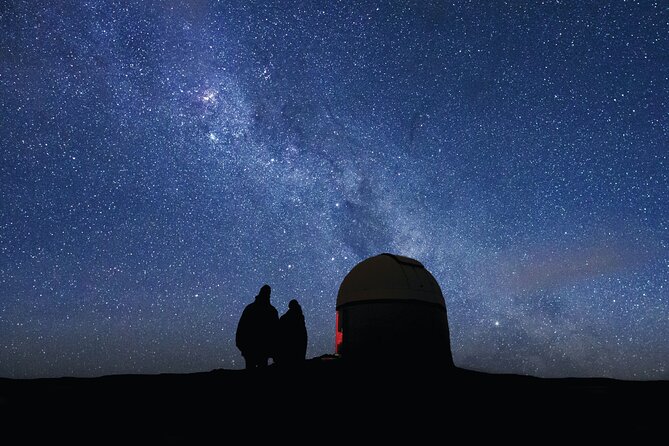
The experience uses advanced observatory equipment rather than a single small telescope passed around a large group. Sessions have included viewing through three telescopes, giving you several chances to see different types of objects.
That variety adds value to the price. You are not paying only for transport and a guide standing under the stars. You are paying for access to a research observatory, specialist equipment, and a structured explanation of what the instruments reveal.
The exact objects cannot be guaranteed. Astronomy is governed by the sky, not a fixed museum display. A cloudy patch may cover an object, or a planet may not be visible at the time of your visit. Guides can work around moving cloud when gaps appear, but they cannot produce a clear view on demand.
The telescope area may also feel busy when the group gathers around the equipment. A little patience helps. The experience is not designed as a private viewing session, and the maximum group size means some waiting is possible.
Cold, darkness, and practical comfort
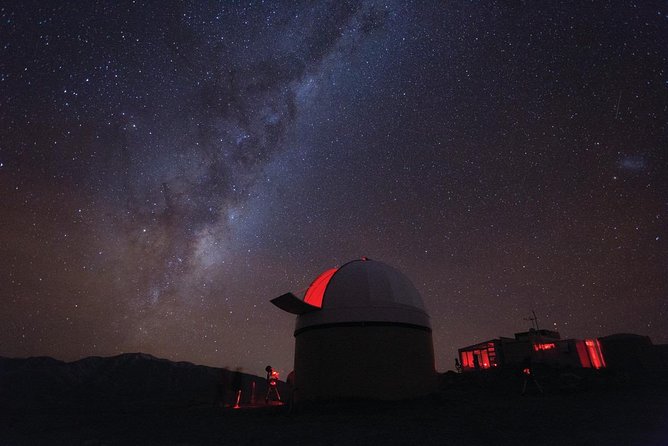
Mount John can be very cold even when Lake Tekapo feels mild. The summit is exposed, and the session takes place outdoors at night. Extreme Weather Coats are supplied, and the coats have been praised for being warm and useful.
You should still wear layers. A warm base layer, fleece or jumper, long trousers, and covered shoes are sensible choices. One visit in spring was described as freezing, despite the season. New Zealand spring does not guarantee a soft evening at 1,029 metres.
It also becomes genuinely dark. White torches and phone lights are not suitable during the stargazing, since bright light damages everyone’s night vision. Stay close to the guide and your group, especially when walking between viewing points. The combination of low light and uneven ground is one reason the activity is not recommended for people with mobility issues.
Children must be accompanied by an adult. Most people can participate, but you should be comfortable standing outdoors, walking in dim conditions, and following safety instructions.
Cloud cover is the big risk
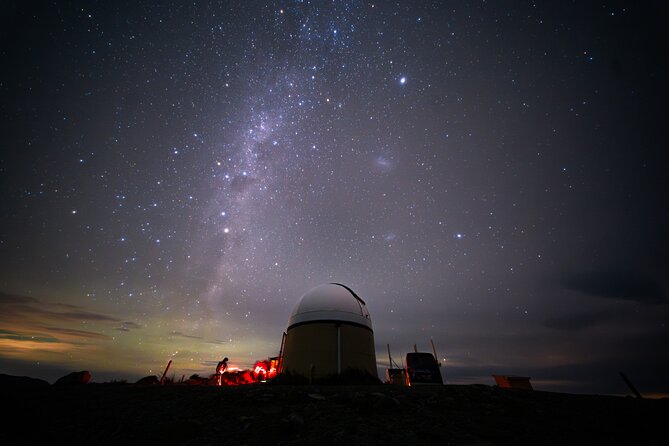
A clear forecast does not guarantee a clear summit. Clouds may arrive, shift, or settle after you have already reached the mountain. The guides can sometimes use gaps in the cloud, and a partly cloudy evening may still reveal the Southern Cross, planets, and other stars.
Complete cloud cover is different. If poor weather prevents the summit session, the operator may offer another date, a full refund, or an alternate indoor experience. The indoor option is a practical fallback, but it is not equal to standing beneath the dark sky. Some visitors found it uninformative compared with the outdoor tour.
This is not a reason to avoid the experience. It is a reason to build flexibility into your Tekapo plans. If you have only one night in town and the forecast is poor, the risk is high. If you have two or more nights, you have a better chance of moving to a clearer departure.
Free cancellation is available until 24 hours before the start time. Canceling later, or requesting changes within that period, does not qualify for a refund. If the operator cancels because of weather, you are offered a different date or a full refund.
Is the $139.39 price good value?
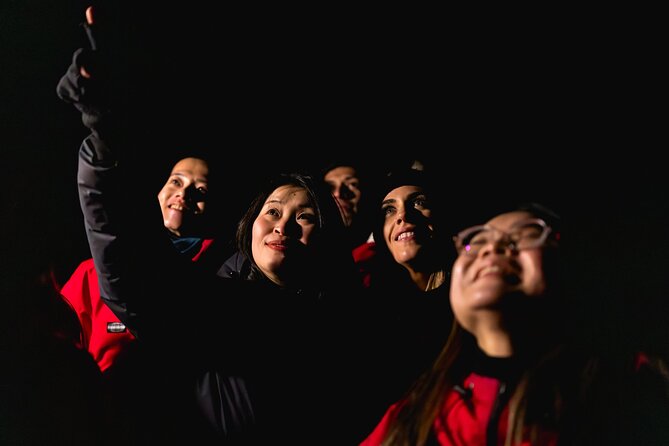
At $139.39 per person, this is not a casual evening walk. The price includes return transport from Tekapo township, summit access, an astronomy guide, naked-eye instruction, telescope viewing, and a cold-weather coat.
I think the value is strongest for someone who wants more than a quick look at the stars. The University of Canterbury observatory setting and advanced equipment give the experience substance. You also receive guidance that helps you understand what you are seeing, which is hard to replicate by simply driving somewhere dark and looking upward.
The value is weaker if you are mainly seeking a photograph or a guaranteed Milky Way view. Wind, clouds, moonlight, and group size can limit what you see. At least one session found the group crowded, and camera restrictions may apply in windy conditions. Do not book this as a photography tour.
For families and astronomy beginners, the price can be justified by the structure and equipment. You do not need to buy or carry your own telescope, learn the southern sky in advance, or work out a safe mountain drive at night.
Who will enjoy this most?
I would choose this experience if you fit one or more of these descriptions:
- You are visiting Lake Tekapo and want one memorable evening activity.
- You enjoy science but do not have much astronomy experience.
- You want to see Southern Hemisphere constellations explained by a trained guide.
- You are curious about planets, star clusters, and galaxies through real observatory equipment.
- You can handle cold conditions, darkness, and some walking.
- You have enough time in Tekapo to move the booking if weather turns bad.
It may not suit you if you need step-free access, dislike standing outdoors, or have only one fixed evening available. It is also a poor match if your priority is photographing the sky rather than learning about it.
What to bring and how to plan
Wear warm layers even though the operator supplies a coat. Your own warm clothing improves comfort, especially around your hands, legs, and feet.
Arrive at the Dark Sky Project in Lake Tekapo township rather than expecting a hotel pickup. Keep the evening free around the 1-hour-45-minute duration, since the listed times are approximate and the mountain transfer is part of the schedule.
Avoid using a white phone light during the session. If you need your phone for the mobile ticket, handle that before the group enters the dark viewing area. The less bright light you create, the faster your eyes adjust.
Check the moon phase if seeing the Milky Way is important to you. A full moon can still make for a worthwhile astronomy lesson, but it may wash out some of the faintest stars.
Should you book the Mount John experience?
Yes, if you want the most structured and accessible introduction to the Tekapo night sky. The guides are the heart of the evening, and the mix of laser-guided constellations, naked-eye viewing, and several telescopes gives the session real range.
Book it with a weather plan, not a weather guarantee. Give yourself another night if possible, wear serious layers, and accept that the sky decides what appears. If you can do that, Mount John offers a memorable look at the Southern Hemisphere from a genuine observatory setting.
FAQ
Where does the experience begin?
Check-in takes place at the Dark Sky Project in Lake Tekapo township. Return transport to Mount John summit is included.
How long does the experience last?
The total duration is approximately 1 hour and 45 minutes. The transfer to the summit is listed as about 15 minutes, followed by around 1 hour and 30 minutes of stargazing.
How high is Mount John Observatory?
The summit is 1,029 metres above Lake Tekapo.
What will I see during the stargazing?
The guide uses naked-eye stargazing, laser pointers, and telescopes to show stars, constellations, planets, star clusters, solar systems, and possibly a distant galaxy. Exact sightings depend on the conditions.
Are telescopes included?
Yes. Telescope viewing through advanced observatory equipment is included in the experience.
Are warm clothes provided?
Extreme Cold Weather Coats are provided. You should still wear warm layers because the summit can be very cold, including during spring.
What happens if the weather is bad?
If poor weather prevents the tour from operating, you may be offered another date or a full refund. An alternate indoor experience may also be offered.
Can children join the experience?
Most people can participate, but children must be accompanied by an adult. The activity is not recommended for people with mobility issues.
Just added around Lake Tekapo
- Lake Tekapo to Mt Cook One-Way Small Group Tour★ 4.0 · 5 reviews
- Lake Tekapo Fishing Tour★ 4.8 · 10 reviews
- Mt Cook Day Tour From Tekapo (Small Group, Carbon Neutral)★ 4.5 · 11 reviews
- Lake Tekapo: Ultimate Stargazing Experience★ 4.3 · 12 reviews
- Lake Tekapo Scenic 4WD Cass Valley Wilderness Tour★ 4.9 · 13 reviews
- Lake Tekapo: Glaciers, Mountains, and Landscapes Scenic Tour★ 4.9 · 15 reviews
- Christchurch: Mt Cook & Tekapo Small-Group Tour (incl Lunch)★ 4.6 · 19 reviews
- Lake Tekapo Scenic Wilderness Cass Valley Tour★ 4.5 · 19 reviews
Lake Tekapo Stargazing, compared.
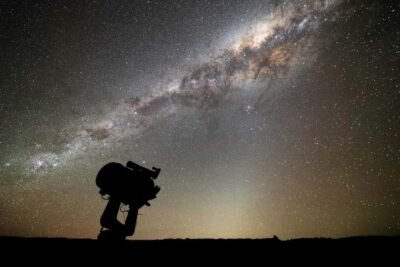
Lake Tekapo: Alpine Stargazing Experience with a Guide
Read our review →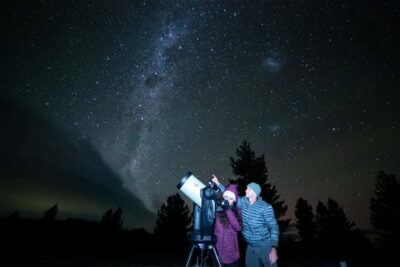
Mount Cook, Lake Tekapo and Tasman Glacier Tour from Christchurch
Read our review →
Mount Cook & Lake Tekapo Day Tour from Christchurch with Lunch
Read our review →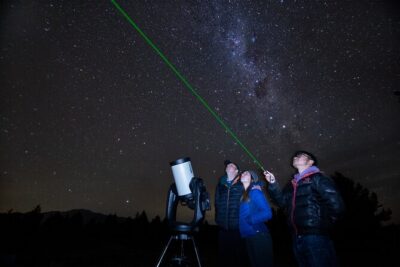
Lake Tekapo: Mountaintop Stargazing at Mount John Summit
Read our review →
Queenstown to Christchurch One-Way Tour via Mt Cook & Lake Tekapo
Read our review →Browse the lists this tour appears in